Bringing a Mission-Critical Intermodal Platform In-House
One Month Early
A Class I railway faced a fixed one-year deadline to take control of the operational platform supporting its domestic intermodal business after the third-party provider announced it would discontinue the service.
The challenge went well beyond moving software. Seven legacy applications had to be transferred and rehosted while the railway built an internal support capability from scratch. Documentation was limited and often decades old, and the outgoing provider did not believe the complete technology and support transition could be achieved within the available year.
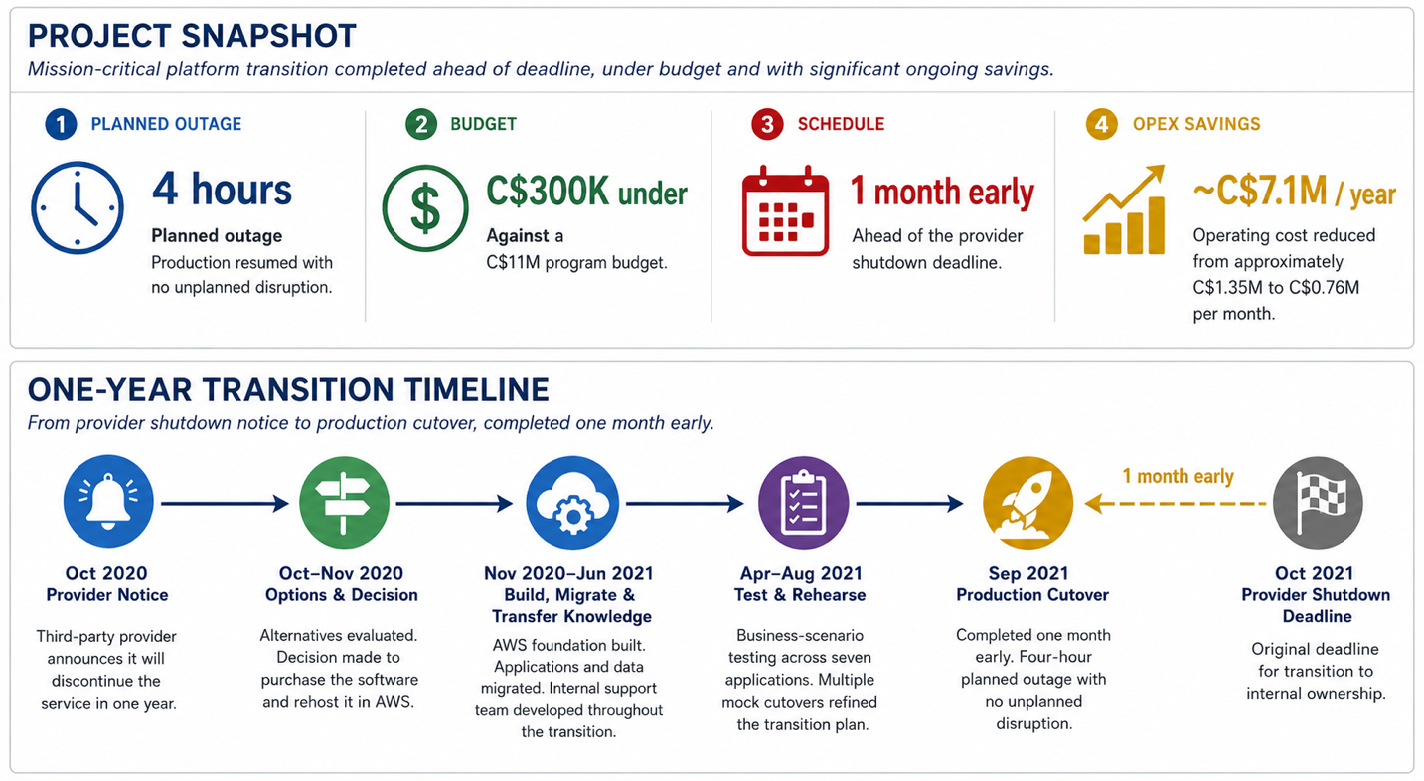
The program moved the platform into AWS, established an internal team capable of operating it, and completed production cutover one month ahead of the deadline. The C$11 million program finished approximately C$300,000 under budget, with a four-hour planned outage and no unplanned service disruption. Bringing the system in-house subsequently reduced operating costs by approximately C$7.1 million per year.
The Business Situation
The platform ran the railway’s domestic intermodal operation and directly supported approximately C$1.8 billion in annual revenue. When the external service provider announced it would discontinue the service, the railway had approximately one year to establish an alternative without interrupting a business-critical operation.
The transition also created an opportunity to address a longer-term constraint. Significant development on the platform had been limited, and improvements specific to the railway’s operation had to compete for space on the provider’s broader product roadmap.
The railway needed to take control of seven legacy applications, establish a new hosting environment, migrate applications and data, transfer operational knowledge, build an internal support organization and validate business processing within the same fixed window.
Current documentation was scarce. Much of what could be found was decades old, leaving important knowledge with people who had operated and supported the system for years. The outgoing provider was cooperative and joined the project team, but did not believe the complete technology and support transition could be achieved within the available year.
Choosing the Transition Path
Before execution began, the project manager developed an evaluation of the available options and presented a recommendation to the CIO.
Alternatives included maintaining a traditional hosting model, moving to another provider, rebuilding the platform, or acquiring the existing software and rehosting it in the cloud.
The recommended path was to purchase the software and move it to AWS. This provided a supported and scalable platform while avoiding the time and operational risk of trying to replace the system within the one-year deadline.
The Approach
A core team of approximately 17 people was assembled from the railway, AWS, implementation partners and the outgoing provider. As specialist resources joined, the extended program team grew to approximately 45 people.
Four delivery choices were particularly important:
- Built the support capability during the migration. The future internal support team worked on each part of the transition rather than waiting for a handoff at the end.
- Reconstructed system knowledge as the work progressed. The team documented workflows, system behaviour and support knowledge during migration.
- Tested business operation, not just technology. Real intermodal business scenarios were used to prove that the platform handled the operation correctly end to end.
- Rehearsed the production transition. Integrated testing and multiple mock cutovers exposed dependencies and reduced the planned outage window to approximately four hours.
Embedding the new support team throughout the migration proved especially important. By cutover, team members understood the individual modules and their dependencies at a level approaching that of the legacy service-provider team.
Results and Business Impact
Production migration was completed one month before the provider’s deadline. The system returned to service after a planned four-hour outage with no unplanned operational disruption.
The program also finished approximately C$300,000 under its C$11 million budget, which included the acquisition of the software.
The financial effect continued after go-live. Monthly operating costs fell from approximately C$1.35 million to C$0.76 million, a reduction of about C$590,000 per month or C$7.1 million annually.
Just as importantly, the railway gained direct control over a platform that had previously depended on an external provider’s priorities. Enhancements specific to its operation could now be evaluated and delivered internally rather than waiting in another organization’s development queue.
The internal team successfully assumed responsibility for production support. The transition therefore changed more than the hosting environment. It reduced external dependency, created sustainable internal capability and gave the railway greater control over how a revenue-critical platform could evolve.
Executive Recognition
In a post-project letter, the railway’s CEO wrote:
“By bringing this critical application in-house … in a new cloud re-hosting environment, you helped eliminate the costs paid … for support while also giving us the opportunity for future innovation.”
Keith Creel, CEO
Experience basis: This case draws on work led by a GovernIT principal while serving as the project manager accountable for overall program delivery at a Class I railway.