Restoring Delivery Momentum in a Global Market-Data
Transformation
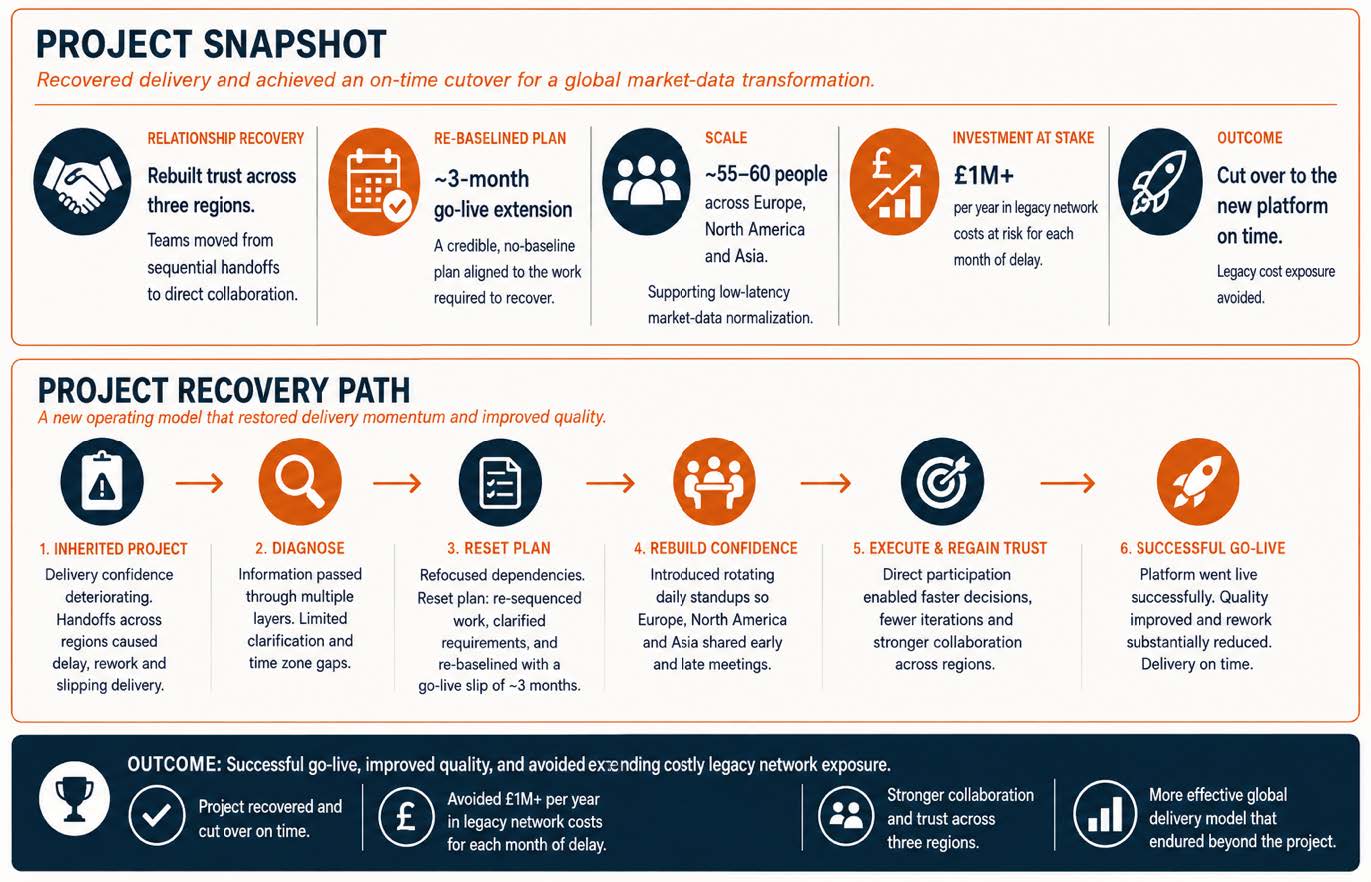
A global financial information and media company was replacing an expensive legacy market-data network with a new internet-based distribution platform. The broader program involved hundreds of people and was intended to reduce substantial ongoing infrastructure costs while preserving the speed and reliability required by financial-market customers.
One project within the program was falling behind. Its teams were distributed across Europe, North America, and Asia, and critical design information was passing through several layers before reaching development and QA. A project manager introduced rotating daily standups across time zones. The new model improved design clarity, reduced rework, enabled effective follow-the-sun delivery, and helped the project cut over to the new platform on time.
The Business Situation
The organization operated a large private network used to distribute financial-market data to brokers, trading firms, and other customers around the world. Speed was a critical part of the service, particularly for customers whose trading systems depended on receiving market information with extremely low latency.
Over time, the private network became increasingly expensive to maintain and harder to sustain as internet-based technologies matured. The company launched a multi-project transformation program to move key capabilities onto a more modern distribution platform.
The business case was significant. Each delay in migration extended the period during which the organization had to continue supporting the costly legacy environment.
The Challenge
This project was responsible for components that normalized ticker data before distribution. The technical work was complex, but the main delivery problem was not the technology itself.
Product and architecture direction originated in Europe, passed to technical leadership in North America, and then reached development and QA teams in Asia. By the time the information arrived, there was often little opportunity for the teams doing the work to clarify assumptions or challenge unclear design decisions.
People filled in the gaps as best they could. The result was avoidable misunderstanding, rework, and slower progress. The project began to drift from its targets.
Earlier attempts at daily standups had not solved the problem because meeting times had been set around Western working hours. The Asia-based team, which represented most of the delivery capacity on the project, could not consistently participate.
What changed
The project manager proposed reintroducing daily standups with one important difference: the meeting time would rotate each week.
Instead of requiring one geography to absorb the inconvenience permanently, Europe, North America, and Asia would share the burden of early-morning or late-night calls. The change was initially unpopular with some team members in Europe and North America, but it created a more equitable operating model and brought the Beijing-based delivery team directly into the design conversation.
The effect went beyond meeting attendance.
Questions that previously travelled through several layers could now be answered directly. Design intent became clearer before development began. Teams were able to identify misunderstandings earlier, which substantially reduced rework and improved the quality of the resulting product.
The rotating schedule also created a practical follow-the-sun model. Each region could complete meaningful work during its day and leave the next geography with clearer decisions, resolved questions, or work that was ready to continue.
An unexpected benefit was meeting discipline. Because someone was often joining outside normal working hours, the team had a strong incentive to keep discussions focused and resolve issues quickly.
Results
The project recovered from its earlier delivery problems and returned to the planned timeframe.
Rework declined substantially as developers and QA staff gained earlier access to product and architecture decisions. Quality improved noticeably, although no verified percentage is available. More importantly, the project completed its cutover to the new platform on time.
That protected the wider transformation from an additional source of delay and avoided extending the legacy network’s operating cost because of this component.
The delivery model also changed the working relationship among the regional teams. The rotating schedule demonstrated that participation across time zones could be shared rather than imposed on one location. Over time, teams that had initially resisted the approach recognized the difference it made to the Asia-based team and the resulting improvement in collaboration.
Business Impact
The immediate result was an on-time cutover of a critical component within a much larger infrastructure transformation.
The broader value came from changing how a distributed team worked. The project moved from sequential, interpretation-heavy handoffs to a more direct global delivery model in which decisions could be clarified quickly and work could progress continuously across regions.
That improvement helped the organization advance its transition away from an increasingly expensive legacy platform without this project adding further delay to the migration.
Experience basis: This case draws on work led by a GovernIT principal while serving as a project manager within a global financial information and media organization.