Locomotive Management & Planning (LMP)
Project Leadership (Project Manager) accountable for leading a large multinational development team, working with the project sponsors, Project Steering and Working committee and technical teams to develop a world class product.
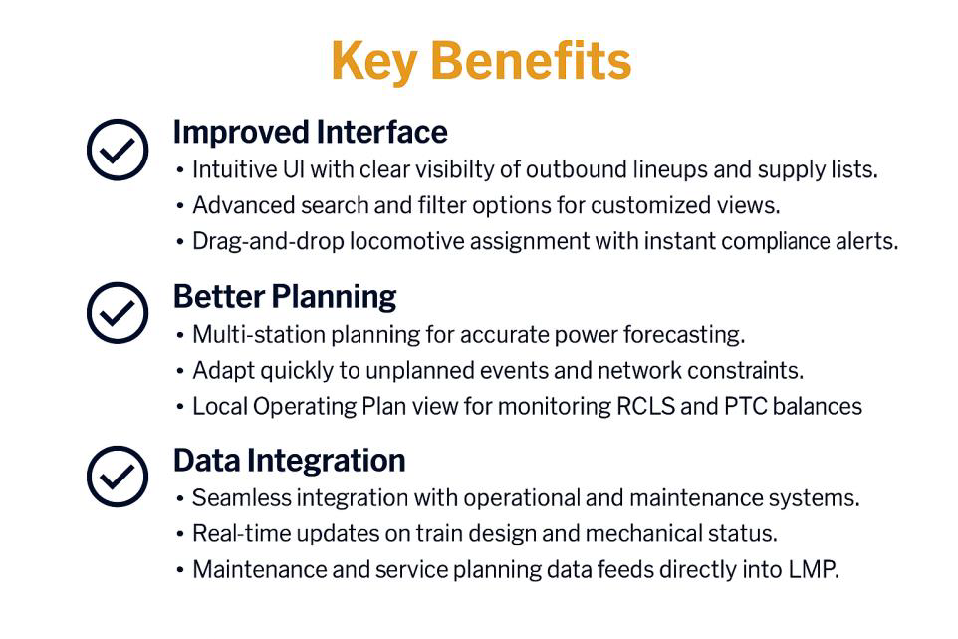
The Locomotive Management & Planning (LMP) initiative modernizes a 30-year-old core operational system responsible for allocating strategic assets to move freight across North America. Previous replacement attempts failed after costs exceeded $10M, leading to project abandonment. Utilization of core SAP Technology, modern interface development and agile development techniques enabled the project to move forward and delivery a best of breed applications that spans a North American railway network.
The solution, built on SAP Transportation and Event Management, utilized UI5 for the interface, became the first application deployed across North America and Mexico following a major acquisition. This transformation delivers operational efficiency, scalability, and integration with critical systems.
Why This Matters
LMP empowers locomotive dispatchers to reduce downtime, optimize asset utilization, and
ensure compliance across a complex network—delivering measurable ROI and strategic
advantage.
Background and Context
- Client Profile: A leading Class I railroad operating across North America, responsible for moving millions of tons of freight efficiently and reliably.
- Business Challenge: The organization faced escalating risk from a legacy mission-critical system that was increasingly difficult to support. Frequent downtime threatened operational continuity, impacting revenue and profitability.
- System Overview: The application managed locomotive allocation, a core function for ensuring freight movement across the network. This system was essential for optimizing asset utilization and maintaining service reliability.
- Legacy Constraints: Built on custom COBOL, creating dependency on scarce technical skills. Complex integrations with modern platforms limited scalability and hindered business growth.
Problem Statement and Objectives
Central Challenge: 30-year-old legacy solution that was becoming difficult to support and impacting the business’s ability to modernize and grow the business with connected systems and critical dependencies between these systems.
Objectives and Success Measures:
- Uninterrupted operational service. Impacting locomotive allocations would have a direct impact on bottom line profitability.
- Modernize toolset into a current product with skills to easily enhance and support the system with skillsets used in other key operational systems.
- Leverage the investments in SAP and harvest the value of a significant investment in a corporate ERP.
- Upskilling the support team with legacy skills on supporting a modern application.
Methodology and Approach
- Delivery Approach: Hybrid methodology combining Agile development workstreams with defined stage gates. Interface development worked on a more traditional waterfall approach given the experience level with Agile on the impacted teams.
- Governance: PMO‑led program with a CIO‑chaired steering committee; weekly CIO reporting; monthly steering committee meetings, weekly working committee meetings, program dashboard for transparency. Extensive use of Decision records to capture key technical, business and project impacts that had the potential to impact scope, timeline or project cost.
- Platforms and Tools: SAP Transportation Management and Event Management with UI5 for the interface layer.
Solution and Implementation
Key Actions:
Innovations and Pivots:
- Significant weather event delayed the planned planned pilot implementation date – dealing with -40 degree weather and keeping network running is core to the business – Deployment of a new system will have to wait.
- Utilization of micro web services for the interface layer was a first for the railway and these services changed the way interfaces have been built since. The original microservice architecture and services have been reused on several projects since initially delayed
- Organization Change manager (OCM) as part of the development cycle and not an afterthought. This approach has been used by the GovernIT team on several subsequent projects with significant success.
- The Projects started out with an in-office team, a dedicated project room and worked through the traditional Forming, Storming, Norming, and Performing steps to build a high performing team. Covid hit about 6 months into the project, the demand for the skills being developed on the project drove several key players into the consulting market and left the project. The core team remained focused and rapidly pivot into a agile team using MS teams and a work from home model to continue to deliver for our end customer.
Results and Impact
- Operational Impact: Minimal impact on the transportation network.
- Budget variance: ~14% under planned spend.
- Schedule variance: Delivered to Schedule.
- Scope: Removed key scope items to add operational critical enhancements early in the development cycle. Business and Steering Committee approved.
- Phased Roll-out approach: System wide adoption in a short period of time.
- Rollback planning: Extensive planning for rollback options to ensure the business impact was mitigated in the event of a failure. Model for future rollback planning activities by GovernIT team.
- Value: First system deployed into a new acquisition and into Mexico as part of a large strategic implementation. Spanish interface added in a phase management by post deployment team.
Top Challenges and Strategic Responses:
- Modernization of Legacy Systems: Transitioning from a legacy solution required a deep understanding of its core deliverables. We adopted a “start-from-scratch” approach, leveraging modern technology to ensure scalability, efficiency, and future readiness.
- Building a High-Performing Team: Assembling a cross-functional team of technical experts and business leaders was critical. This collaborative structure enabled faster decision-making and alignment with organizational goals.
- Upskilling for Innovation: Transforming a legacy team into a modern SAP development powerhouse involved targeted training and mentorship. This investment in people ensured seamless adoption of best practices and accelerated delivery.
Lessons Learned:
- Strong Governance Through Decision Documentation: Capturing critical design decisions in formal decision documents and securing timely approvals established a solid design foundation, enabling future projects to build on proven architecture.
- Seamless Transition to Production: Regular sprint reviews and structured knowledge transfer sessions with third-party developers ensured a smooth handover. Core teams successfully transitioned from COBOL to SAP—a significant upskilling effort achieved without disruption.
- Proactive Risk Management: Project leadership maintained a laser focus on risk throughout the life cycle. Early identification and mitigation planning allowed issues to be addressed well before realization, ensuring delivery confidence.
- Organizational Change Management as a Strategic Priority: Recognizing OCM early in project initiation was critical. Onboarding a dedicated team to manage rebranding, communication, and training plans ensured stakeholder alignment and adoption ahead of production roll out.
- Data Foundation First: Prioritizing Master Data Management early in the process guaranteed a robust data foundation, enabling the successful build of a strategic operational system on reliable, accurate information.
Conclusion and Call to Action
Key Takeaway: Leading large teams on strategic initiatives is important but must align with effective decision making and communications across the organization. A project manager manages, but some projects need a project leader that can trailblaze strategic applications to deliver.
Call to Action: Ask us how we can help you make your impossible a reality.