


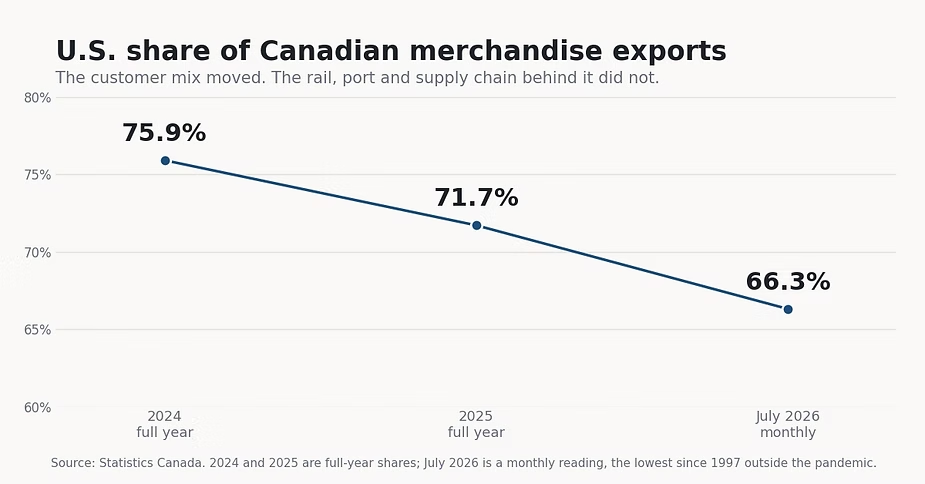
Canada’s share of merchandise exports going to the United States fell from 75.9% in 2024 to 71.7% last year, and Statistics Canada clocked July at 66.3%, the lowest reading since 1997 outside the pandemic.
That is a remarkable shift in the customer mix, and it has not yet moved a single rail line.
The Wall Street Journal reported today that Mark Carney is exploring whether Canada could hold some form of associate membership with the European Union. The status does not exist yet and building it would be politically difficult, which is part of what makes the attempt worth watching.
The scope being discussed runs well past market access, into energy, defence, critical minerals, undersea cables, data centres, cloud and satellite infrastructure, and the physical means to move Canadian energy across the Atlantic.
A list like that describes rails, cables, terminals and long-term contracts. Many of those take years, sometimes a decade, to build and then quietly decide where commerce is able to go.
Nearly ten points between the 2024 annual share and this July’s reading shows how quickly the destination mix can change.
It also shows what does not move at that speed.
Supply chains, rail and port capacity, financing relationships, certification bodies and decades of commercial habit were all built north to south, and none of that re-routes because a minister signs something in Brussels.
The same gap shows up inside companies, and it is easier to miss there because the revenue number moves first.
A board asks for diversification. Sales delivers a European logo on the customer list, everyone agrees the concentration risk is being managed, and the slide goes into the annual report.
Meanwhile the supplier base, the financing, the cloud tenancy, the certifications and the logistics partners all still sit in the market that everyone agreed was the risk.
Revenue diversification is the visible half. The operating-model half is harder because it requires procurement, treasury, IT, compliance and operations to move together, often on a timeline longer than the current fiscal year.
If you want a read on your own position, list your ten most critical dependencies and mark the ones where a non-US alternative has actually carried operating load rather than simply been identified on a slide.
That gap is your exposure, and it is usually wider than the executive team expects.
Close it and the second market carries load when the first one gets difficult.
Leave it and you find out during the disruption, which is the most expensive possible time to learn it.
Canada is at least asking the harder version of the question.
Building a credible answer will take years.
Which dependency in your business would be slowest to re-route, and how long do you honestly think it would take?